




A recent decision of the Full Court of the Federal Court concerning packaging of grocery products, confirms the test to apply in assessing what is a ‘substantial part’ of a work in the context of copyright infringement proceedings.
Hampden manufacturers baby and child food products sold under the names Baby Bellies, Little Bellies and Mighty Bellies (together, Baby Bellies). The packaging for these products often features distinctive characters and fonts, as well as images of the ingredients of the products.
The Aldi grocery chain developed a line of baby and child food products (under the name Mamia) to be sold in its own supermarkets to rival Hampden’s products.
Hampden commenced copyright infringement proceedings against Aldi claiming that the pack designs on the Mamia products infringed the copyright in the Baby Bellies products. They claimed that the packaging of the Mamia products adopted design features and visual elements of the Baby Bellies products, such as the use of a two-dimensional cartoon character, the use of childlike fonts and images of ingredients – in other words, the “look and feel” of the packaging.
Applicable Law
Artistic works, such as the design and images featured on food packaging, are works capable of protection under the Copyright Act 1968 (Cth).
A person infringes another person’s copyright in an artistic work if they, among other things, reproduce a substantial part of that artistic work.
Importantly, the assessment of what is a ‘substantial part’ of a work requires a qualitative assessment, not a quantitative one – even a quantitatively small part of an artistic work may amount to a substantial part of the copyright work if it constitutes a ‘vital or material part’.
The degree of originality in the copyright work is also relevant. As a general rule, the greater the originality, the more likely that any amount of copying will infringe.
Primary Judgment
At first instance, the trial judge held that three Aldi pack designs (Aldi Works) infringed the copyright in Hampden’s packs (Hampden Works).
Some of the similarities found in relation to two of the relevant works included:
- a small oval-shaped cartoon character, with a large, light-coloured belly;
- a two-column layout;
- a rounded, childlike font; and
- a number in the upper-right corner.
On appeal, Aldi queried the approach to assessing infringement, arguing that the primary judge considered the elements of the parties’ respective packaging at too high a level of abstraction, with the effect that the differences in those elements were incorrectly overlooked.
Appeal Judgment
The Full Court held that, in assessing whether a work reproduces a substantial part of another, it is necessary to consider the originality of that which is copied. Such assessment requires a ‘multifaceted analysis’, which was not undertaken by the primary judge.
Importantly, merely identifying the elements of similarity between the works is not the end of the inquiry. Rather, a side-by-side comparison of the relevant pairs of works is required to determine whether a substantial part has been reproduced, having regard to all of the similarities and differences which are present.
In this case, identifying features at a high level of abstraction and noting whether they were present or not present had prevented the trial judge from engaging in a nuanced analysis of the extent of similarity, as is required. Attempting to generalise a claim to a common ‘look and feel’ is not the appropriate course for a copyright case either – that is more relevant for a case alleging misleading and deceptive conduct.
For those reasons, the Court allowed Aldi’s appeal that the primary judge had erred in their approach to the assessment of copyright infringement. However, when the Court then proceeded to conduct side-by-side comparisons of the Aldi Works and the Hampden Works, it found more examples of infringement than found by the trial judge, making Aldi’s victory on the legal argument entirely pyrrhic.
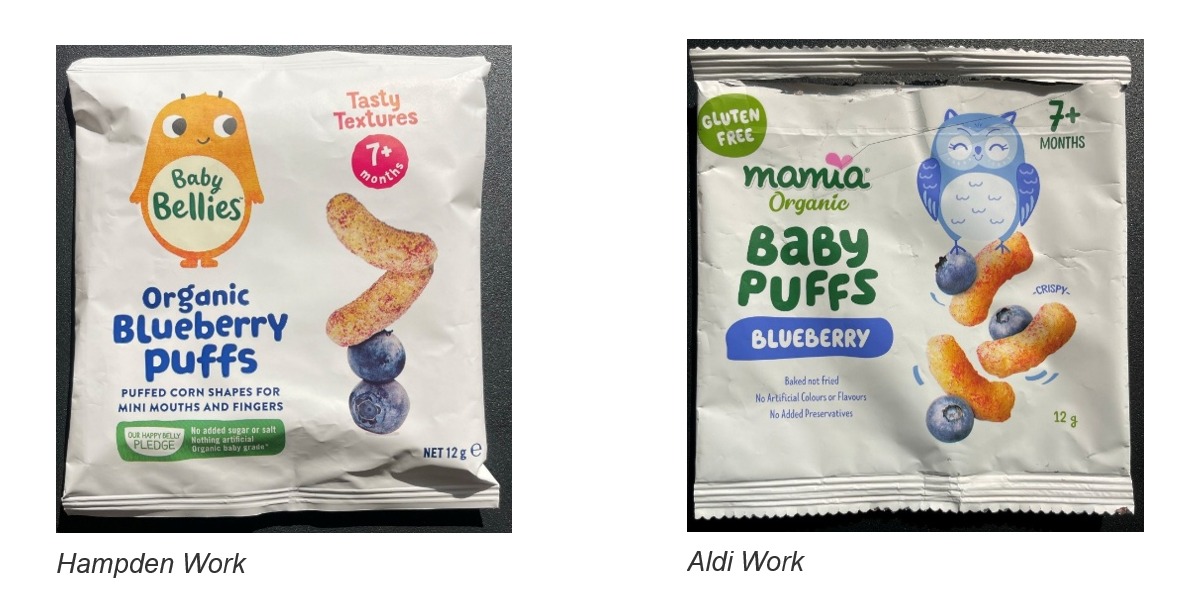
By way of example, in relation to the works pictured above, the Court reasoned that:
- photographs of the product and ingredients in the Aldi Work were sufficiently similar to the equivalent part of the Hampden Work so as to amount to a reproduction of that element;
- the photographs of the product and ingredients, combined with the other elements of similarity (eg, colour palette, age indicator, childlike font, cartoon character) lead to the conclusion that a material part of the Hampden Work had been taken;
- the material in the public domain did not support Aldi’s submission as to the elements of the Hampden Work, taken together, being commonplace; and
- the creation of the Hampden Work involved a degree of skill, effort and creativity and a material part of that skill, effort and creativity had been appropriated in the Aldi Work.
Key Takeaways, especially when considering marketing artwork and pack design
The decision confirms that when assessing potential copyright risks in competing artworks, it is inappropriate simply to weigh up the similarities and the differences and, on a balance, come to a view as to whether a substantial part has been reproduced. The assessment requires a more nuanced consideration of the works considered as a whole. In this sense, the decision acts as a timely reminder that ‘substantial part’ is assessed qualitatively, not quantitatively.
More broadly, copyright infringement does not merely involve copying the ‘look and feel’ of a work, but rather, involves copying which is identified in a side-by-side comparison of the impugned work and the copyright work.
You can read the full decision here.
For more information about this case or to discuss how to protect or enforce your valuable intellectual property assets, reach out to a member Addisons’ Intellectual Property team.