




A recent Full Court of the Federal Court decision provides an important reminder for consumer brands and retail businesses developing new packaging, refreshing brands or launching private label products.
The case highlights that copyright disputes can arise even where designers do not directly replicate an entire pack design, and that courts will undertake a detailed visual comparison of competing packaging when assessing infringement.
What happened?
The dispute concerned baby food products sold by Hampden Holdings under the Baby Bellies range and competing products sold by Aldi under its Mamia brand. Hampden alleged that Aldi’s packaging adopted elements of its pack designs, including cartoon characters, childlike fonts, ingredient imagery and other visual features.
The Full Court confirmed that copyright infringement is not determined by asking whether two products have a similar “look and feel”. Instead, the question is whether a substantial part of the original artistic work has been reproduced. That assessment requires a detailed side-by-side comparison of the relevant artworks and consideration of the originality of what has been copied.
Importantly, although Aldi succeeded on a legal argument about the correct approach to infringement, the Full Court ultimately identified additional examples of infringement when it conducted its own detailed comparison of the packaging.
Examples considered by the Court
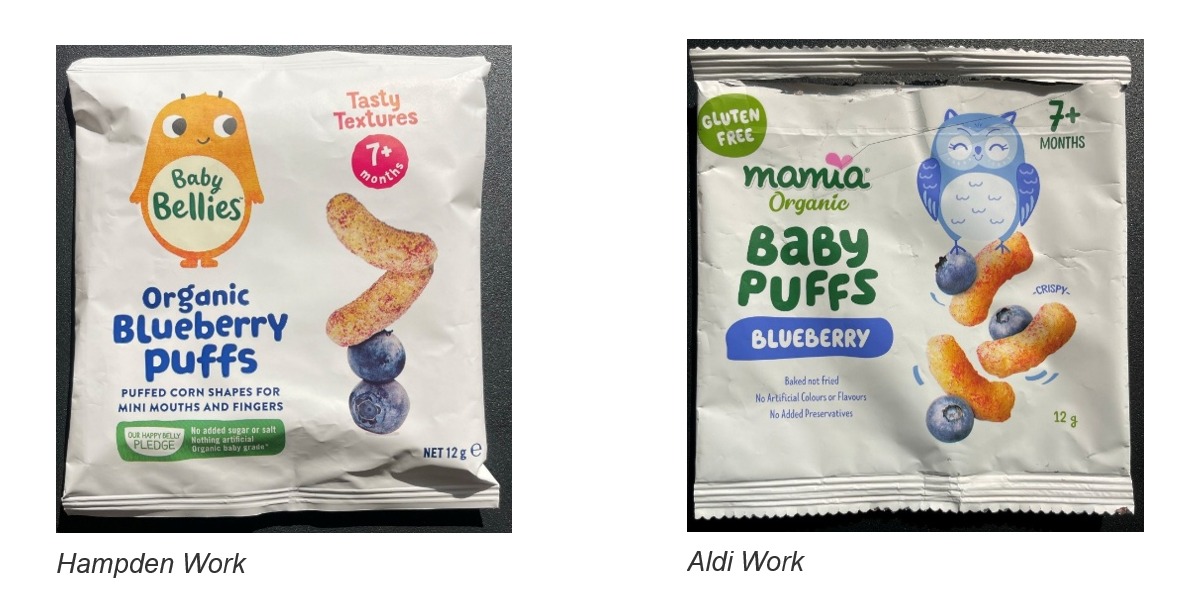
The Court found that similarities in product photography and ingredient imagery, together with other design elements such as colour palette, age indicators, childlike fonts and cartoon characters, contributed to a finding that a material part of the original work had been reproduced.
What does this mean for consumer brands and retail businesses?
The decision is a warning that copyright risk can arise from the combination of design elements used on packaging, not just from copying logos, brand names or entire artworks.
Businesses developing new products, own-label ranges or packaging refreshes should assume that courts will compare the overall artistic expression embodied in the packaging and closely examine whether original creative choices have been appropriated.
Practical steps to reduce copyright risk
1. Do not design by reference to a competitor’s packaging
Avoid instructing designers to create a pack that looks “similar to” a market-leading product. Where a competitor’s packaging is used as a benchmark, there is a risk that distinctive artistic elements may be carried across into the new design.
2. Create independent artwork
Ensure key creative elements are developed independently, including illustrations and characters; product and ingredient photography; graphic devices and icons; typography; layouts; and colour combinations used in distinctive ways.
The greater the originality of the competing work, the greater the copyright risk associated with reproducing those elements.
3. Look beyond individual elements
Do not assume that changing individual components is enough.
A designer may avoid copying a logo or character but still create infringement risk if the overall combination of design features appropriates the creative skill, effort and originality reflected in a competitor’s pack.
4. Conduct a documented side-by-side review
Before launch, compare proposed packaging against major competing products in the category. Then ask:
- Are the same graphic motifs being used?
- Is the layout substantially similar?
- Are distinctive characters, illustrations or image treatments comparable?
- Has a similar combination of creative elements been adopted?
5. Use special care with private label products
Private label products often seek to signal category equivalence to consumers.
However, efforts to create a familiar appearance can cross the line where original artistic elements from branded products are reproduced.
Packaging that is “inspired by” category leaders should therefore be reviewed carefully before production.
6. Keep records of the design process
Maintain evidence showing how packaging was created, including design briefs, concept iterations, source imagery licences, photographer and illustrator agreements and internal approvals.
These records can be valuable in demonstrating independent creation and ownership if a dispute later arises.
For more information about this case or to discuss how to protect or enforce your valuable intellectual property assets, reach out to a member of Addisons’ Consumer Brands & Retail team.